Recovering a Sense of Power

Happy Sunday!
I’m currently in the process of completing The Artist’s Way, Julia Cameron’s 12-week creative recovery program, and documenting my experience in this series of Substack posts.
Lessons from the Text
This week, Cameron invited readers to open themselves up to synchronicities indicating that the universe may be cooperating with their desires to live a more creative life. To illustrate this concept she gave a number of theoretical examples, such as a woman wanting to become an actress and then meeting a man who teaches acting, or someone wanting to watch a rare film and then finding it at a bookstore a few days later. Cameron asked readers to notice and keep an open mind about synchronicities; to view them not as coincidences but as the sign of “an intelligent and responsive universe, acting and reacting in our interests”.
The text also discussed how shame can impair our ability to create, and that the antidote for shame is self-love and self-praise. Artists can experience a sense of shame for creating art at all, or after being criticized for the art they produce. There is a section of the chapter where Cameron discussed how to deal with critique and discern constructive criticism from criticism given in bad faith.
Tasks
The text and tasks this week invited a lot of reflection on childhood. Cameron asked readers to recall their favourite childhood toys, games, foods and movies; their childhood bedrooms; traits they liked about themselves as children, and childhood achievements.
One of the traits I admire most in myself as a child is what I call my “shamelessness”- my total confidence in my creative talents and lack of fear in showing them off. I recalled how in the sixth grade I was one of a few students in my school selected to sing the national anthem on the morning announcements. I am in awe of the fact that my eleven-year-old self had it in me to proudly belt out “Oh Canada” to hundreds of students and teachers at 8am in the morning.
The exercises this week led me to reflect on the type of art I created when I was younger (namely, throughout my undergraduate years and young adulthood). My creations in my late teens and early twenties were almost all visual- primarily pen and ink drawings, acrylic paintings and digital photography. The subjects in my drawings and paintings varied, but when it came to photography, I was always either documenting the world around me or doing self-portraiture.
Even though I’m still guilty of taking too many phone selfies, I am definitely not the subject of my own work the same way I was in my young adulthood. In fact, much of the art I’ve produced over the past few years feels completely impersonal. Even when writing these Substack posts, I find myself holding back some thoughts and feelings. I am afraid to share myself with the world. A goal for myself moving forward is going to be finding a way to make my art more personal again.
Artist Date
For my artist date this week, I got dressed up and took myself to the Art Gallery of Ontario (“AGO”) on Friday evening.
The prospect of conquering an entire museum in an evening was daunting- the AGO is quite large and houses many diverse collections from a variety of different artists. I decided that instead of going in with a plan, I would just browse the gallery at my own leisure and pace.1 My goal was not to think too hard about anything, try to have fun, and expose myself to different types of art and see what I was drawn to.
I have, of course, been to the AGO many times throughout my life and have some favourite pieces that I gravitate towards regularly- including Yayoi Kusama’s Infinity Mirrored Room (I first encountered and fell in love with Kusama’s installation art in 2018 when the AGO housed her Infinity Mirrors exhibition) and Henry Moore’s haunting sculpture collection (which always evokes an emotional response in me).


There were also some “newer” (to me) pieces and collections that I was drawn to. One of these included an exhibition of 20 woodcut prints by Japanese-Canadian artist Naoko Matsubara. I was unfamiliar with this medium and fascinated by what Matsubara was able to create with it. My favourite pieces in her collection were a pair of self-portraits she created almost 60 years apart. Comparing the two portraits, I could really appreciate how much her technique had changed and evolved throughout her lifetime.
I was also drawn to pieces from The Group of Seven in a way I never have before. Growing up in Ontario, it was impossible not to be familiar with the Group of Seven- the iconic, exclusive group of Canadian artists which operated in the 1920s and 1930s and specialized in Canadian landscape paintings. I was intrigued by the Group’s lush, colourful and dynamic depictions of Canada and the importance that they placed on both capturing the visuals as well as the “mood” of a place.2
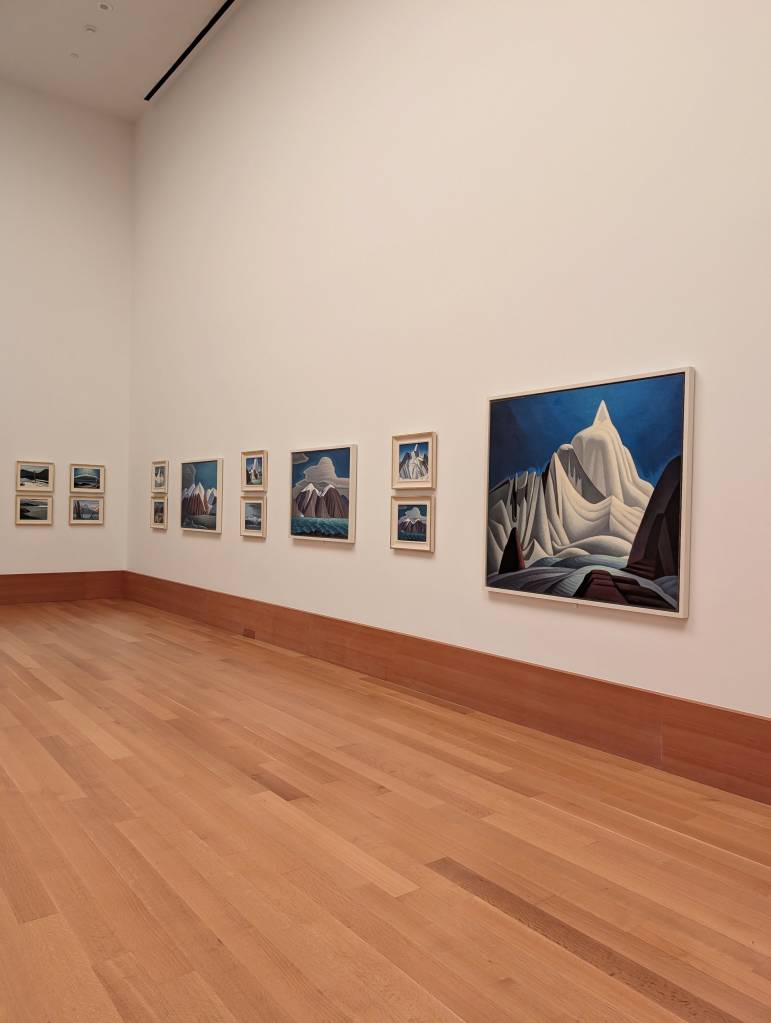
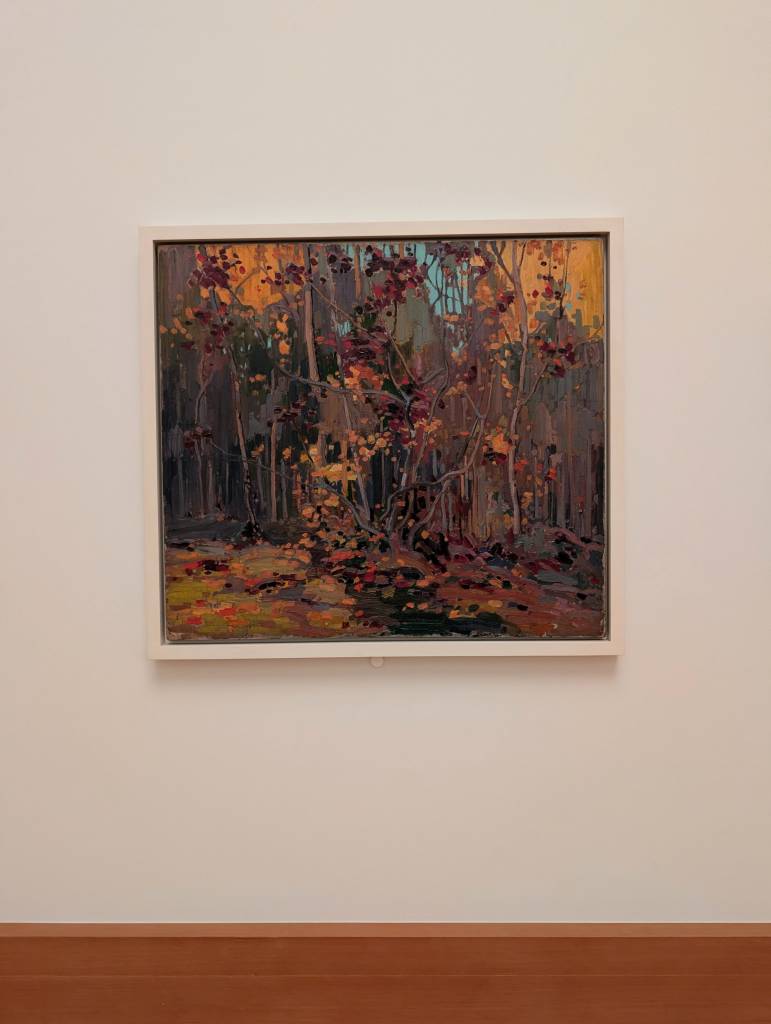
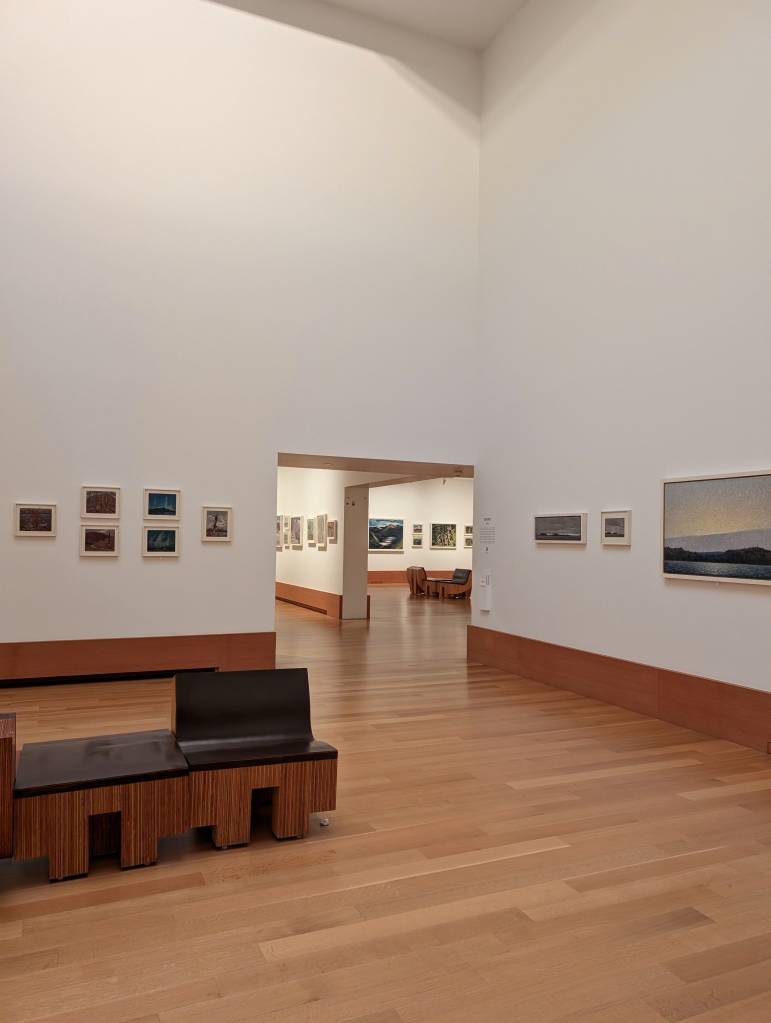
Finally, I was drawn to several photography pieces. What drew me to them was the “slice of life” element- the photos were not staged, the photographers were just documenting scenes as they existed. I looked at pictures of rural farmland in Northern Ontario, a brassy fountain in Rome, and a cluttered bookstore in Vancouver. This is the type of photography I am most drawn to- photography that attempts to capture the world in its ordinary beauty.
I spoke earlier in this post about wanting to be more personal with my art again- and I think photography would be a good place to start. I would like to start documenting my life, as it is, in pictures again. Moving forward in my journey with The Artist’s Way, I am going to set myself the task of finally fixing and re-learning how to use my old DSLR camera. For an upcoming artist date, I would love to take my camera out somewhere familiar, and nostalgic, and take pictures.
Until next week-
Laura Kate
- I ended up buying an annual pass- for only $10 more than general admission- so that I’ll have no excuse but to go back to the gallery again (and soon). ↩︎
- There is a lot that can be said, and has been said, about the Group of Seven’s goal of creating a “distinctly Canadian art style” and treating Canada as though it was an untouched land before European colonization- as if Indigenous peoples hadn’t been living and creating art in Canada for centuries already. ↩︎
 Laura Katherine