The Artist’s Way: Week Two Reflections

Recovering a Sense of Identity

Happy Sunday!

I’m currently completing The Artist’s Way, Julia Cameron’s seminal 12-week creative recovery program, and documenting my experience and reflections in these posts. Each week of The Artist’s Way involves reading a chapter from the accompanying text, completing a handful of tasks, writing daily morning pages and going on an artist date.

Lessons from the Text

The second week of the program targets recovering a sense of identity. Admittedly, a lot of the text this week did not resonate with me. In it, Cameron talks about setting boundaries with people in our lives who may be hindering our creativity (including “poisonous playmates”, other unsupportive, blocked artists; and “crazymakers” who demand our time and attention).

The part of the chapter that interested me was a section titled “Skepticism” where Cameron invites us to open our minds to the possibility that “the universe” may be encouraging and cooperating with our creative desires. She illustrates this idea with the story of an artist named Mike:

“When Mike began his creative recovery, he let himself admit that he wanted to make films. Two weeks later, through a series of “coincidences,” he found himself in film school with his company paying for it. Did he relax and enjoy this? No. He told himself that film school was distracting him from his real job of finding another job. And so he gave up filmmaking to look for another job.

Two years later, remembering this incident, Mike can shake his head at himself. When the universe gave him what he wanted, he gave the gift right back. Eventually, he did let himself learn filmmaking, but he made it a lot harder on himself than the universe may have intended.”

When I was writing my morning pages this week, I reflected on my desire to be a novelist even though I struggle with my longform fiction projects. I find myself constantly bored, unhappy or overwhelmed when writing longform fiction, but have always found other types of art to come more easily- for example, drawing, writing nonfiction (such as essays and blog posts) and writing short stories. I asked myself why I have never taken short form writing more seriously, and why it was so important to me that I become a novelist instead of pursuing another path. I have always considered myself to be fairly agnostic when it comes to the question of whether there is a higher power in the universe (skeptical, but open-minded). But, this week, The Artist’s Way made me reflect on whether someone or something might be pushing me in a specific creative direction. I thought about what it might mean to try leaning into what feels easy and fun rather than pushing myself to do things that feel challenging and unrewarding.

Tasks

This week, I created a list of things I enjoyed doing and reflected on the last time I did them, drew a “life pie” illustrating my fulfillment with different aspects of my life, and came up with 5 more “imaginary lives” to build on the list started last week.

Most notably, however, was a task which asked me to list 10 changes I wanted to make for myself (“from the significant to the small”). Without thinking too much about it, I made a list- and almost everything on the list involved lifestyle maintenance work. “I would like to… vacuum my floors”. “I would like to… do an audit of my personal finances.” “I would like to… get better at bringing a lunch on days I go to the office for work.” I wondered whether I’d done the task wrong (and maybe I had), or, in the alternative, why lifestyle maintenance work was so important to me. In any event, making the list inspired me to do some lifestyle maintenance tasks, including cleaning my apartment. This ended up being good for me- I tend to be more creative in organized environments (when I’m not distracted by clutter and chaos around me).

Artist Date

For my artist date this week, I took a few hours and experimented with watercolour painting from the comfort of my apartment. I dimmed the lights, lit a candle, made myself a mug of tea, and turned on a watercolour 101 video I found on YouTube (The Complete Beginner’s Guide to Watercolour by Jenna Rainey).

The video covered a variety of topics from recommended art supplies to colour theory to actual watercolour techniques. I treated it like a real class: taking notes and practicing my technique alongside the video. Toward the end of the video, where the artist started to teach viewers how to paint a wreath, I opened up another one of her videos and followed a tutorial on how to paint a colour wheel instead.

I definitely did not create any artistic masterpieces this week, but I was happy that my artist’s date gave me the chance to experiment with a new medium that I am largely unfamiliar with. I have used watercolour in my paintings before, but without knowing anything about the medium- my technique was largely trial and error.

The theme of my artist’s date this week was “play”: I focused less on creating a perfect piece of art and more on learning and exploring. I look forward to continuing to paint with watercolour throughout this program and beyond.

Until next week-

Laura Kate
The Artist’s Way: Week One Reflections

Recovering a Sense of Safety

I am currently in the process of completing Julia Cameron’s 12-week creative recovery program, The Artist’s Way. Each week of the program involves reading a chapter from The Artist’s Way text, completing a handful of tasks, writing daily morning pages, and going on an artist date.

Lessons from the Text

The first week of the program focused on (re)establishing a sense of safety around creating art. According to Cameron, to create without fear, it is important that artists feel encouraged and supported. Artists who harbour negative beliefs about creating may need to take some time to break down and dispel those beliefs.

A key concept Cameron introduced was the “shadow artist”. A shadow artist is someone who possesses artistic talent and drive, but does not consider themself to be a true artist. They “hide in the shadows” with their artistic desires, and may instead befriend established artists or choose careers which parallel their desired arts (Cameron gives examples of journalists who really want to write fiction and movie critics who want to be directors). Many shadow artists don’t think that they’re talented enough to be true artists- but, as Cameron assures, “very often audacity, not talent, makes one person an artist and the other a shadow artist”.

Cameron also discussed core negative beliefs that might be holding shadow artists back from identifying as “true artists”. Examples include believing that one’s artistic ideas are not good enough, that one can never achieve financial stability as an artist, or that becoming an artist would hurt one’s relationships. To counter these negative beliefs, Cameron suggested making use of creative positive affirmations (i.e., “my ideas are good enough”, “artists can be solvent”, “artists can have thriving relationships”).

Reflections

The text this week led me to reflect on my own identity as an artist. To use Julia Cameron’s language, over the years, I have definitely become a “shadow artist”. I still struggle with feeling like a “fraud” when referring to myself as an artist, and I have doubts about my abilities. In order to move forward in my creative recovery, I definitely need to start taking my art more seriously.

Tasks

One of the tasks for this week involved reflecting on my past and listing 3 “old enemies” of my creative self-worth (i.e., people who contributed to my negative core beliefs about being an artist). This task made me realize that I have been quite fortunate- my creative aspirations have always been met with much more support than discouragement. This said, when I traced the roots of one of my beliefs that art should be a hobby rather than something for me to take seriously, I realized I probably inherited the belief from my parents. Although my parents were avid supporters of my creative self-development in childhood, when it came time to consider my future, art was not something that my parents encouraged.

While I have distinctive memories of crafting with my mom and grandmother when I was a child, I also remember a conversation I had with my mom in grade 8 telling me I could never make a living as a graphic designer. Similarly, despite my parents signing me up for art and music classes and theatre camps as a tween, I was also encouraged to drop a creative writing elective in the twelfth grade to make room for a physics class. The message was clear: art was supposed to be something fun, not something to take seriously.

Another task this week involved a thought exercise- “what would you do if you had 5 other lives to lead?”. For this exercise, I chose paths that sounded fun, but that didn’t seem practical (anymore) based on my current life trajectory:

  • A theatre actress
  • A barista
  • A marine biologist
  • A teacher, and,
  • An influencer.

The second part of the task asked me to choose one of the paths and “do” some aspect of it. I decided to try my hand at being a barista by making an iced pumpkin spiced latte (can you tell I’m already ready for fall?). I roughly followed this recipe (3 tbsp pumpkin pie filling, 1/2 tsp pumpkin pie spice and 1 cup of oat milk blended together and poured over ice with an espresso shot)- it was delicious!

Morning Pages

I’m proud to say that I completed my morning pages every day this week. I’m finding them fairly easy to do- I’m never at a loss for internal dialogue to write down. I think I’m already starting to see the value in writing morning pages- I understand how the exercise is meant to teach artists to go through the motions of creating every day (even if they don’t feel up to it) and, importantly, without judging a product as it’s taking shape. I’m hoping to internalize this process and utilize it when I try my hand at writing fiction again in the future.

Artist Date

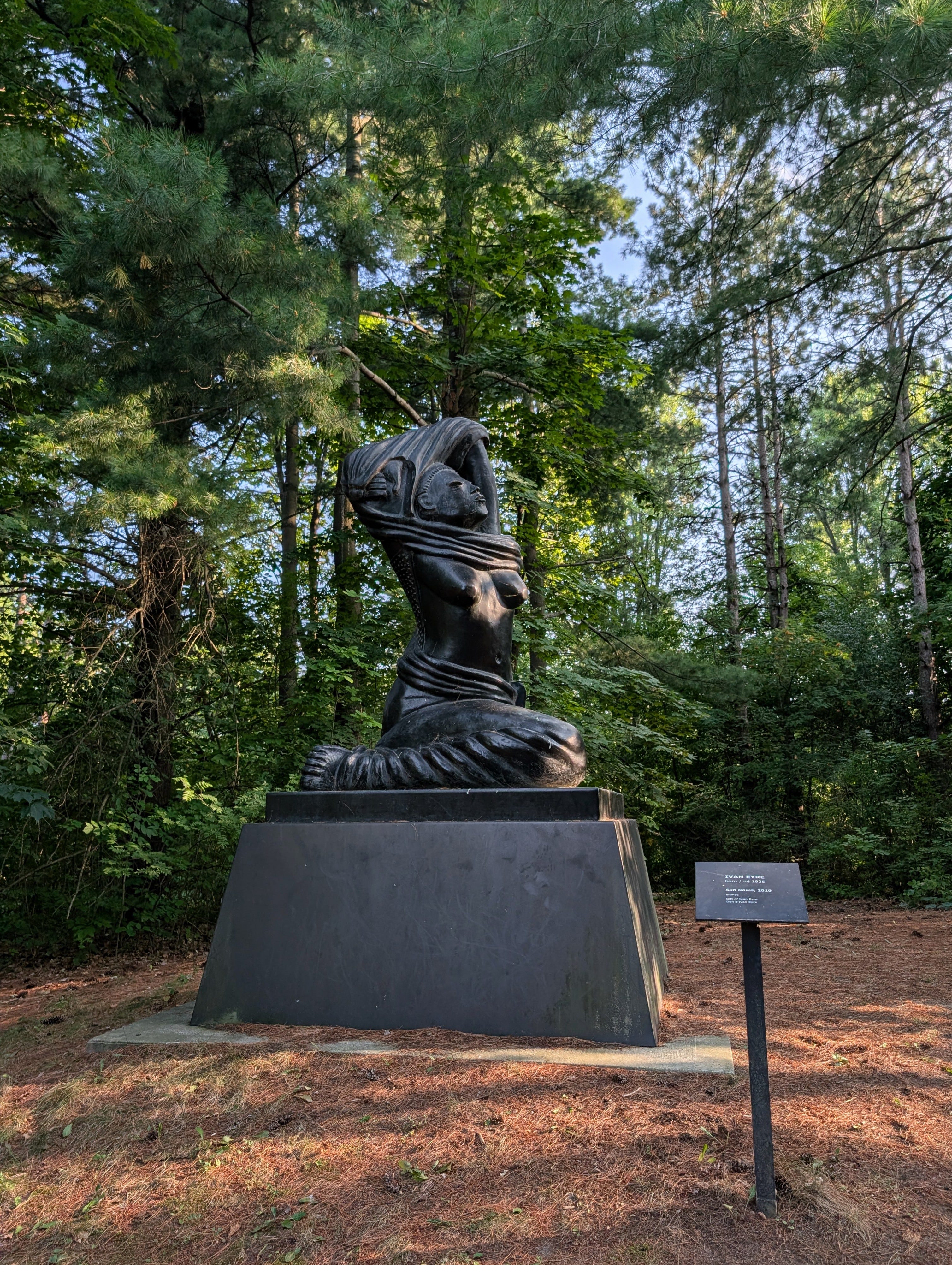
For my artist date this week, I took myself to the McMichael Art Gallery sculpture garden in Kleinburg. It consists of 9 bronze statues donated to the Gallery by Winnipeg-based artist Ivan Eyre.

For an hour while I walked alone through the Gallery grounds, I turned my phone on airplane mode and listened to the sounds of cicadas and birds in the surrounding forest.

I spent some time with each statue in the collection, but one in particular that stood out to me was Sun Gown (2010). It made me reflect on the interplay throughout the exhibit between art and nature. Sun Gown depicted a woman sitting and stretching; her face incidentally turned toward the setting sun. Beams of light streamed down through the foliage overhead and fell on her body. She was literally being gowned by the sun’s rays. I imagined I must have been seeing the sculpture exactly the way Eyre had intended.

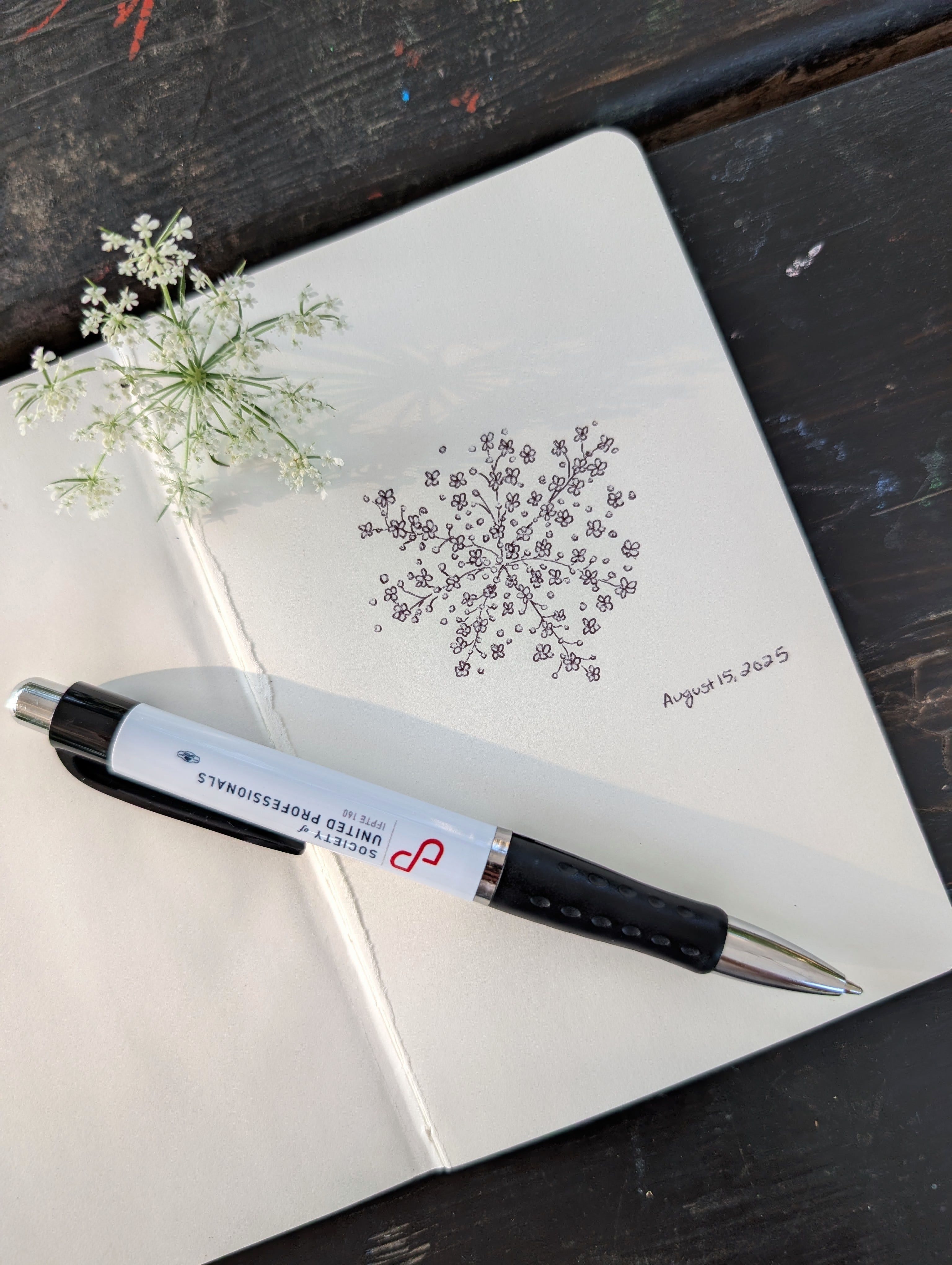
After walking through the sculpture garden, I sat down at a picnic table for a few minutes, and inspiration struck to doodle a Queen Anne’s Lace flower I’d found. Even though the sketch is nothing impressive, I’m glad to have it as a souvenir from the date to look back at.

Until next week,

Laura Kate

The Recovering Artist

If you asked me 10 years ago to describe myself, I would have defined myself by my creative hobbies. I would have said I was a writer or a cartoonist; a photographer or a videographer.1 If I was feeling bold, I may even have called myself an artist or a creative in general.

This all changed in 2018 when I started law school. To say that law school took over my life would be an understatement. A mentor in my early legal career once told me that in order to succeed as a lawyer, one has to let the law consume them. Succeeding (or, more accurately, treading water) in the legal profession required me to eat, sleep and breathe the law. The process of becoming a lawyer shaped me into a different person with a new way of thinking, and left me with little time or enthusiasm for creative pursuits.

I realized very early on in my legal career that although I found my work to be interesting, important and impactful, being a lawyer was not “spiritually” fulfilling. Something was missing- in particular, the joy and fulfilment I had always felt when creating. I quit my job in private practice, moved to the public sector (which offered more flexible working hours) and tried to rekindle my creative passions, but was never able to reignite the spark I once had. I continued to take pictures, though, only on my cell phone while my DSLR camera sat gathering dust. I took a handful of creative writing classes, but was only able to write in short spurts in response to assignment deadlines. Today, if you ask me to define myself, I will tell you I’m a lawyer.

A few days ago, I picked up a copy of Julia Cameron’s The Artist’s WayThe Artist’s Way is a book, originally published in 1992, containing a 12-week creative recovery program. I’d heard about The Artist’s Way before- in fact, thousands of creatives have been very vocal about working through the program themselves, including author Elizabeth Gilbert, rapper Doechii and singer Olivia Rodrigo.

The Artist’s Way interests me insofar as it promises to help me get over my artist’s block and encourage me to live more creatively. So- I am making the decision to start the program for myself, beginning August 11.

The Artist’s Way involves doing daily and weekly tasks, including writing morning pages (“three pages of longhand writing, strictly stream of consciousness”) and going on artist dates (“a block of time… especially set aside and committed to nurturing your creative consciousness”).

In The Artist’s Way, Julia Cameron speaks about the importance of “filling your well” of creative resources to draw upon in your work. You fill your well by feeding yourself sensory experiences- sights, sounds, smells and tastes. This notion made me reflect on how much of my sensory experience these days comes from the internet; and, in particular, social media. It led me to question whether social media is really a good place to be deriving inspiration. The types of sensations we experience from social media are limited. Our feeds are driven by algorithms, which limit the amount of “new” or “challenging” content we see. We are shown the same type of content, over and over again, because the algorithms know we will look at it. Finally, because social media are designed to keep users on their platforms for as long as possible, we spend a lot more time than we should, or even want to, online.

With all of this being said, I decided that an essential part of committing myself to The Artist’s Way program will involve disconnecting as best I can from social media. This will mean no Instagram, Facebook (with the exception of Messenger), Pinterest or Reddit. Perhaps most painfully, I will also be drawing strict boundaries around my YouTube use. I hope that by curbing my time on social media, I will leave myself open to experiencing the world beyond the 4 corners of my screen.

Julia Cameron would seem to agree with this approach. She describes the creative recovery process as a withdrawal “from” life as we know it “to” our creative selves. In order to (re)establish our identities as artists, we need to distance ourselves from our set routines and ways of thinking- much like I had to do in the process of becoming a lawyer.

This is where Substack comes in. Even though I am taking a hiatus from traditional social media, I still want an outlet to share and document my life throughout this 12-week journey. I am hoping Substack can be that for me. As far as I can tell (I am admittedly completely unfamiliar with the platform), Substack seems to offer users more freedom and flexibility than traditional social media with less distracting properties.

While taking part in The Artist’s Way, I am not committing myself to one artistic medium in particular. I am leaving myself open to creating in any way inspiration happens to strike. Beginning to regularly post on Substack seems to be the start of a new creative pursuit as well. I hope you, the reader, stick around to accompany me through this journey.

With love,

Laura Kate

  1. I would have also told you I was a Gemini Enneagram 4w5 Ravenclaw, but that’s neither here nor there. ↩︎