A few days ago, I ran my second half-marathon race.1 It wasn’t easy, and it took a lot out of me to make it to the finish line, but I’m happy to say that the Toronto (Half) Marathon is now in the books.
I trained for the race with a roughly fifteen-week plan designed to take me from my winter “running maintenance routine” (wherein I was running three times a week and maintaining the ability to comfortably run 10km) to a 21.1 kilometre distance at a quicker pace. This meant that quite a bit of my training took place during the brutal winter we had this year in the city. I did as much running as possible outdoors, which meant becoming an expert at dressing for the elements. Each week throughout my training, I went on three runs (two shorter and one longer) and tried to incorporate strength training once or twice. It was tough, but very rewarding. I proved to myself that I could be tough and adaptable, especially in less-than-ideal weather conditions. I saw a significant improvement in my pace throughout the training, especially during the taper period.
This said, I was a little apprehensive in the weeks leading up to the race. Most of this came from hearing horror stories about past Toronto Marathon events, including overcrowding, the organizers running out of water for participants, and incomplete road closures putting runners in precarious positions. The novelty and excitement of running 21.1 kilometres had also started to wear off: by race day, I had already run the distance three times before, including just a few weeks prior on April 12. Fortunately, once I picked up my bib and other runners on social media started to post more about it, I started to look forward to the race.
And then, the unthinkable happened. On the evening of Friday May 1, roughly thirty-six hours before the race was set to begin, I found myself in bed, curled up in a ball, so nauseous I couldn’t even stand. Things only got worse from there: I had a terrible sleep on Friday night and woke up on Saturday exhausted, with a splitting headache, and a still-unsettled stomach. I ended up spending almost the whole day on the couch watching TV. My plans to pick out my race outfit in advance, get a shakeout run in, or even carb-load evaporated. It took everything in me to force down PopTarts and plain white rice. I went to bed on Saturday night assuming that I would have no choice but to sit the race out the next morning.
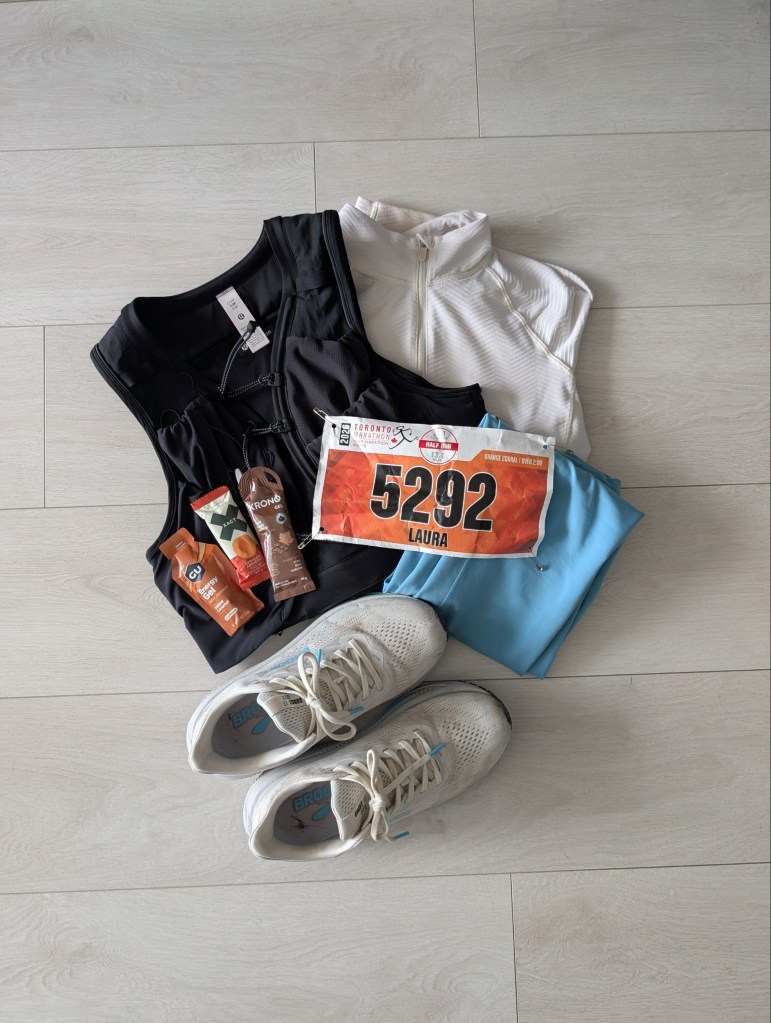
Miraculously, I was wrong. I woke up at 5:00am (thanks to my cat) on Sunday, May 3 feeling absolutely fine, aside from the smallest bit of stomach upset. I ended up popping an Advil and making the decision to run. Going into the race, especially given my mystery illness the day before, my goals were simple: first and foremost, cross the finish line, and, second, if possible, beat my previous race time of two hours and eleven minutes. I gave myself unconditional permission to stop running and drop out if I started to feel even a little bit sick during the race.
The weather was perfect- it was mostly sunny, and the temperature fluctuated between seven and ten degrees. I wore a baseball hat, long leggings and a long-sleeved shirt with my hydration vest on top. The shoes I wore were my beloved Brooks Ghost 17 GTXs.
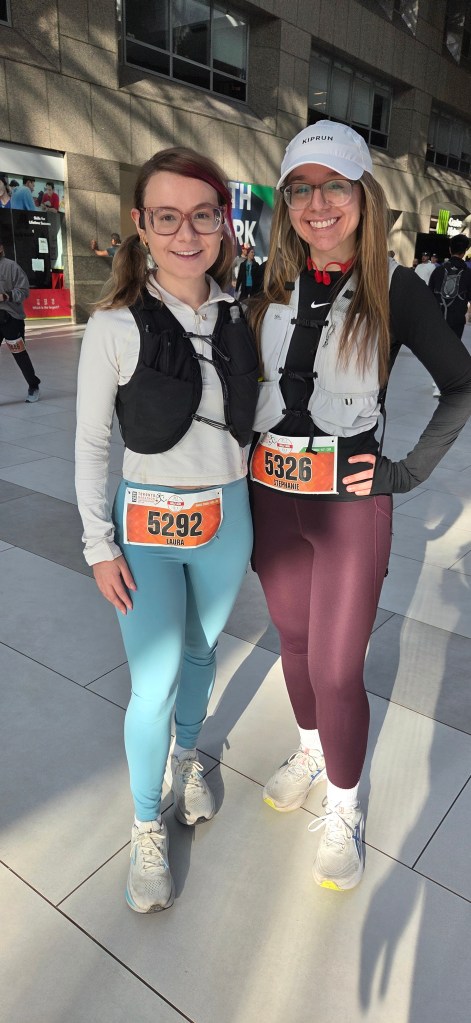
The Toronto Marathon is generally known for having a great route. The half-marathon course started in North York, at Yonge and Elmwood, and continued south down Yonge street. The first few kilometres were very hilly- mostly downhill, but with a few notable periods of elevation. I ran the first few kilometres alongside my friend Stephanie, but then lost her at a water station. After that, I found my boyfriend in the crowd around the five kilometre mark. There were some frustrations that were obvious from the start of the race- namely, major overcrowding on the course. There were thousands of runners, and I don’t think start times were staggered very well. Also, only half of the lanes on Yonge street were actually closed off. This led to a lot of congestion throughout the entirety of the race. I found myself weaving through and hitting or getting hit by other runners or veering into live lanes of traffic throughout the whole race. Stopping or slowing down at water stations made this even more difficult to navigate.
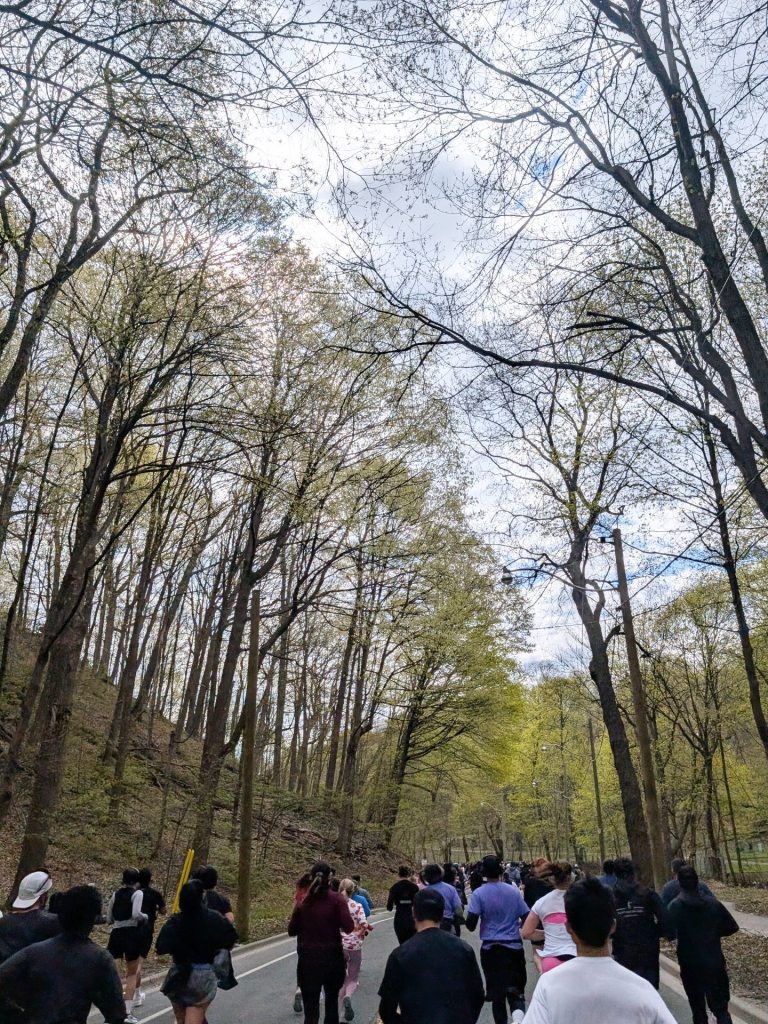
At about the halfway point in the race, the course turned off of Yonge Street and onto Rosedale Valley. This was easily the most scenic part of the race with lush, green foliage overhead. It was here that I looked down at my smart watch and realized I was making exceptionally good time. I ended up making the gametime decision to try and finish the race in less than two hours. A sub-two half-marathon was not a goal I ever set for myself, even before I got sick. I didn’t incorporate any speed training into my plan, and had no pacing strategy for the race. I generally find that focusing on speed tends to detract from my enjoyment in running. I’m also very liberal about stopping or taking walking breaks on my runs to stretch, take gels or drink water.
Predictably, making the decision to attempt a sub-2 half marathon totally changed the race for me. Once I set myself a time goal, I lost focus on the route, my music and enjoying myself. The only thought I had throughout the second half of the race was, “keep going”. I started to hit some crazy (for me) paces- 5:15 mins/km (at km 17), 4:53 mins/km (20)… even 4:31 mins/km (19). Ultimately, my efforts paid off and I ended up finishing with an official time of one hour, fifty-nine minutes and twelve seconds. I hate to define a run by my finishing time, because it’s really antithetical to my entire running philosophy, but the truth is that I ended up making this race about speed rather than the experience as a whole.
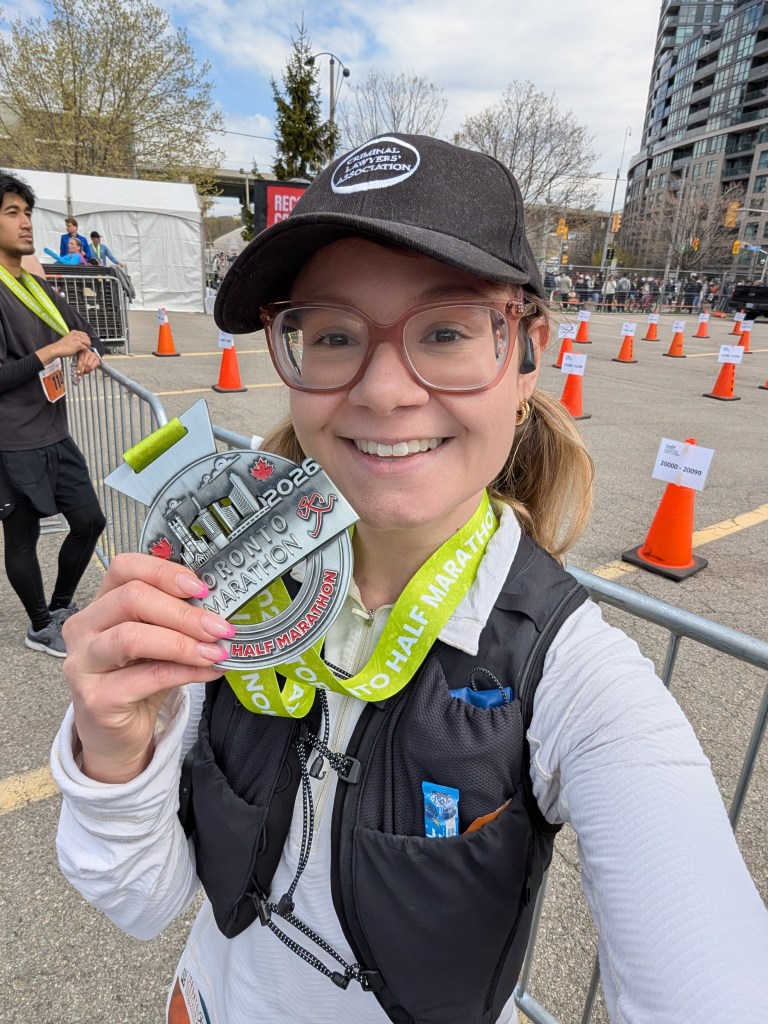
The finishing chute was probably the most disorganized part of the race. I crossed the finish line to thousands of people crammed into a tiny, fenced-in area to get medals, bags, food and water (the race organizers actually did end up running out of water at the finish line when I was passing through). I managed to fight my way through the crowd for an oversized medal and one banana before leaving with my partner.
Overall, despite the hiccups, I did have a good race and I’m so proud of myself for making it through the months of training and across the finish line. I’m so grateful to my body for being able to push through everything. I really showed myself I can do hard things and exceed my own expectations.
I’m confident these are lessons I can bring forward with me in the future, when- drumroll please– I’ll be training for my first full marathon.
Until next time,
Laura Kate
- The official event was the Toronto Marathon which hosts a full marathon, a half-marathon, a 10k and a 5k. ↩︎
 Laura Katherine