On October 18, 2026, I officially became a marathoner at the Toronto Waterfront Marathon. I can honestly say that the race itself, as well as the time I spent training for it, was one of the most difficult things I’ve ever done, both physically and psychologically. I don’t think I’ve ever spent so much focused time in pursuit of a goal, and I’m so proud of myself for making it to the finish line.
The Training Block
I started my twenty-week marathon training plan in early June. Throughout the training block, I ran four times a week: three shorter runs on weekdays (with mileage between about 5km and 11km) and one longer run on the weekend. I also started off strength training once or twice a week, but this eventually fell to the wayside: I was overwhelmed by the volume of exercising I was doing, and I never really liked strength training anyway. Unfortunately, quitting strength training ended up coming back to bite me during the taper, but I’ll circle back to that later.
Increasing my activity level so much meant having less flexibility in my schedule and less time for recovery. I used up a lot of my vacation days at work and missed out on a lot of activities I would have otherwise said yes to, such as hanging out with friends, going on vacations or even making time for hobbies. I was also constantly worrying about what I was eating and ensuring I was getting enough calories, carbohydrates and protein to fuel my activities. I talked more about this in a post I made in August, “Marathon Training is Taking Over My Life”.
Nonetheless, I persisted, and it was incredible to see what I accomplished over the course of twenty weeks. I was able to run for longer than I ever dreamed of, accomplishing training runs that were 29, 31 and even 33 kilometres long. I saw new parts of Toronto, running the west end of the Martin Goodman trail and a really beautiful trail network in Newmarket. My favourite runs were always the long runs, no matter how challenging they got. They felt indulgent; I was spending hours outside, exploring new and scenic places.
The Taper
The last three weeks of my training plan were when everything fell apart. I’m sure I wasn’t alone in going through what I went through- it’s not uncommon for runners to experience “taper crazies” or “maranoia” characterized by illness, phantom injuries, and anxiety in the weeks immediately leading up to a race when they’re cutting down their running mileage and trying to prioritize rest and recovery.
Week Eighteen started off with (minor) ankle pain in my achilles tendon. My anxiety blew things completely out of proportion, and I convinced myself I had developed achilles tendonitis and would have to drop out of the race. I ended up going to two physiotherapists who prescribed daily stretching and a reduction of the mileage in my training plan, but who both assured me I’d still be able to run the marathon. They chalked the pain up to a lack of consistent strength training and doing too much activity too soon after my 33-kilometre long run.
Then, Week Nineteen brought illness. I started my cycle and got a very bad cold. Nonetheless, I decided to continue following my training plan because I didn’t want to reduce my running mileage even further after slashing it the previous week. This ended up being a huge mistake: at the height of my illness, I went on a 15-kilometre run which felt awful from start to finish and wiped me out for the rest of the day. In my defence, at this point in the training plan after running half-marathons or more every weekend all summer, 15 kilometres honestly seemed like a relatively short and easy distance to run, even if I was sick. In any event, the morning after the run, I fainted, and had to see a doctor and have some tests run at the ER. It was determined that the fainting was likely caused by me being sick, not hydrating or fueling properly, and then getting out of bed too quickly in the morning. My family doctor ended up giving me the “okay” to run the marathon if I felt totally recovered on race day, followed a hydration plan, and vowed to stop running immediately if I showed any symptoms.
Despite being cleared to run by my doctor and two physiotherapists, all of these events left me feeling very anxious and doubtful about whether I could run the marathon at all.
My final run before race day was on October 16. I did a short 6.5-kilometre run around my neighbourhood and felt fantastic. This final run gave me the confidence I needed to make my way to the race expo in Liberty Village and pick up my bib and race kit. I even ended up buying a Waterfront Marathon-branded shirt and tote bag; something that I hoped wouldn’t bring me more bad luck.
Race Day
When I first started training for the marathon in June, I set three goals for myself. My “A” goal was to finish the race, my “B” goal was to finish in under five hours, and my “C” goal was to finish in under four and a half hours. These objectives stayed consistent throughout the majority of my training block, and, if you’d asked me immediately after my 33-kilometre run, I would have said I was confident that I would achieve all of them.
Unfortunately, because of everything that went wrong during the taper, I had to re-adjust my expectations. Going into the race, I no longer had any real time goals. My only goal was to stay safe and healthy, which meant that if I had to stop running at any point, I would back out. But mainly, I wanted to cross the finish line, no matter how long it took.
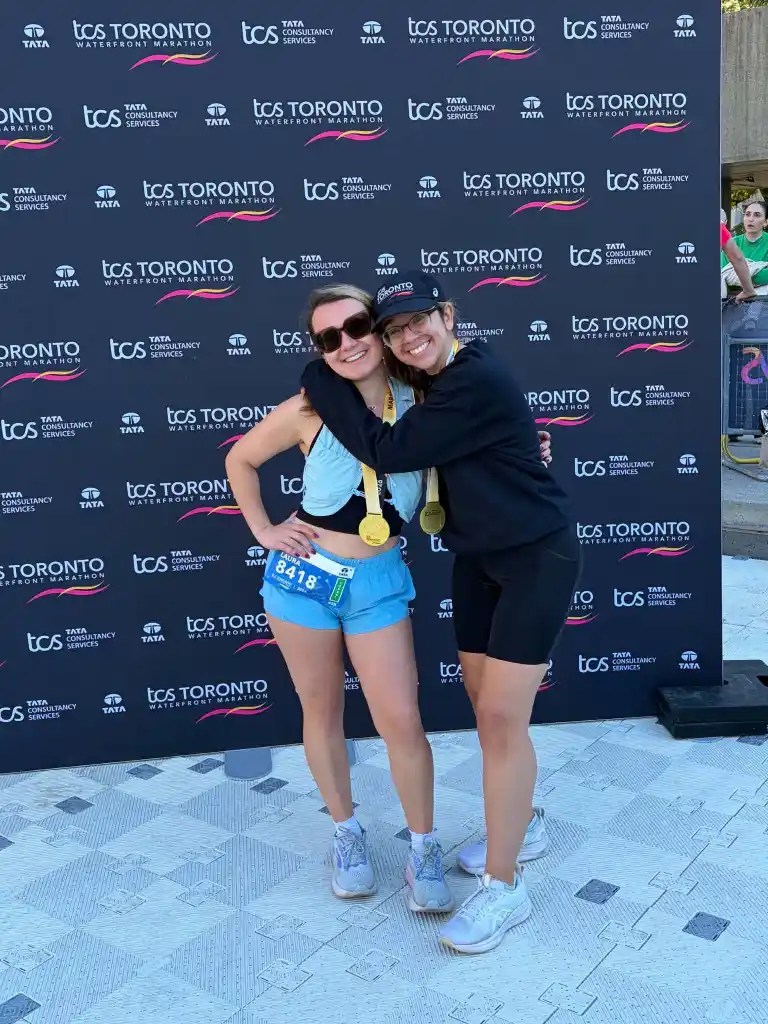
To add insult to the injury of my taper, I came to race day with just three and a half hours of sleep after tossing and turning for hours the night before. But the race day energy was contagious once I got to the start line. The weather was perfectly cool and sunny without a cloud in the sky. I also got to begin the run alongside my friend, Stephanie, who was running her first marathon as well. The shared experience of training had brought us so much closer together, and getting to run with her, if only for an hour or so, was very special.
My race strategy was to stay hydrated (taking water at every single aid station on the course) and fuel consistently (taking energy gels every 30 minutes). I was aiming to run at a slow, comfortable pace at first (well over six minutes per kilometre), with the presumption that I’d be able to speed up later. Though, as it turned out, my splits for the first and second halves of the marathon were almost the same: I ran the first 21.1 kilometres in two hours and seventeen minutes and the second half in two hours and twenty-one minutes.
The first half of the race went well. I ran at a comfortable pace and crossed the halfway point feeling like I had a lot of energy to continue. I ran the Toronto Waterfront Half-Marathon last year, so I was familiar with the first half of the course. It’s enjoyable- mostly flat or downhill with lots of spectators.
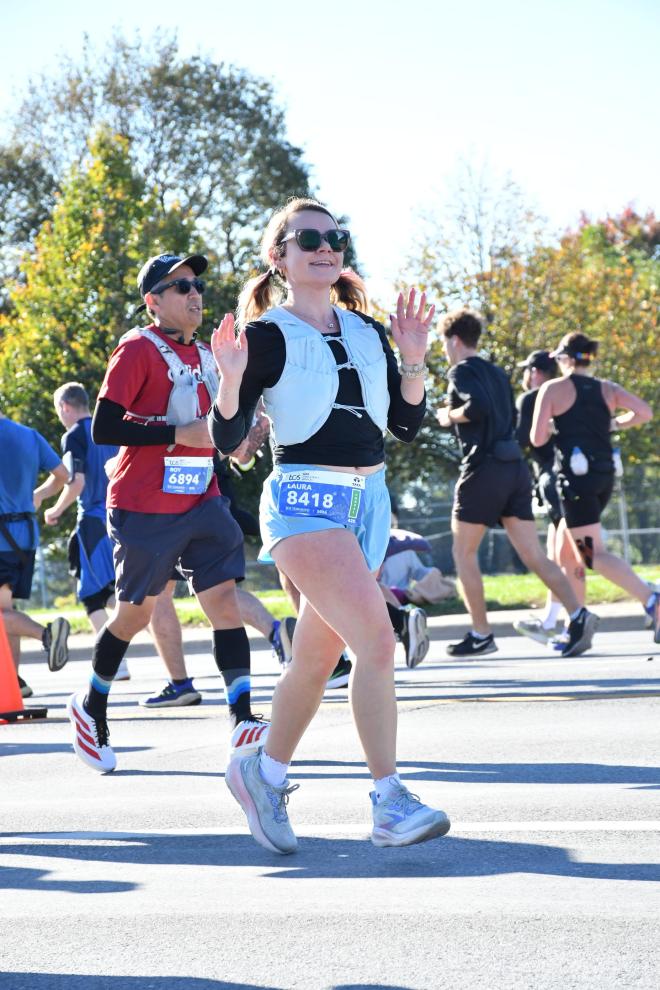
The second half of the marathon was where things started to get difficult. The second half of the course was a lot quieter: there were fewer spectators and the vast majority of runners who started the race had dropped off at the half-marathon point. At about kilometre twenty-four, I was ready to stop; my hips and legs were screaming at me in agony. Still, I wasn’t experiencing any concerning symptoms like lightheadedness, so I knew I was safe to keep running.
I ended up having some spectators of my own in the second half of the race. I saw my boyfriend, who biked downtown, around kilometres twenty-five, thirty and thirty-five; and my parents at kilometres thirty-two and thirty-four. Seeing friendly faces in the crowd cheering me on lifted my spirts, and made me really appreciate having people in my life who tolerated months of me complaining about training for the marathon and who supported me every step of the way.
Kilometre thirty-six was where things went from bad to worse, because my headphones died. Suddenly, especially with fewer runners and spectators to watch, I had nothing to distract me from the pain my body was in. My legs really started giving up on me at this point, and I actually ended up taking a liberal number of walking breaks from that point until the finish line.
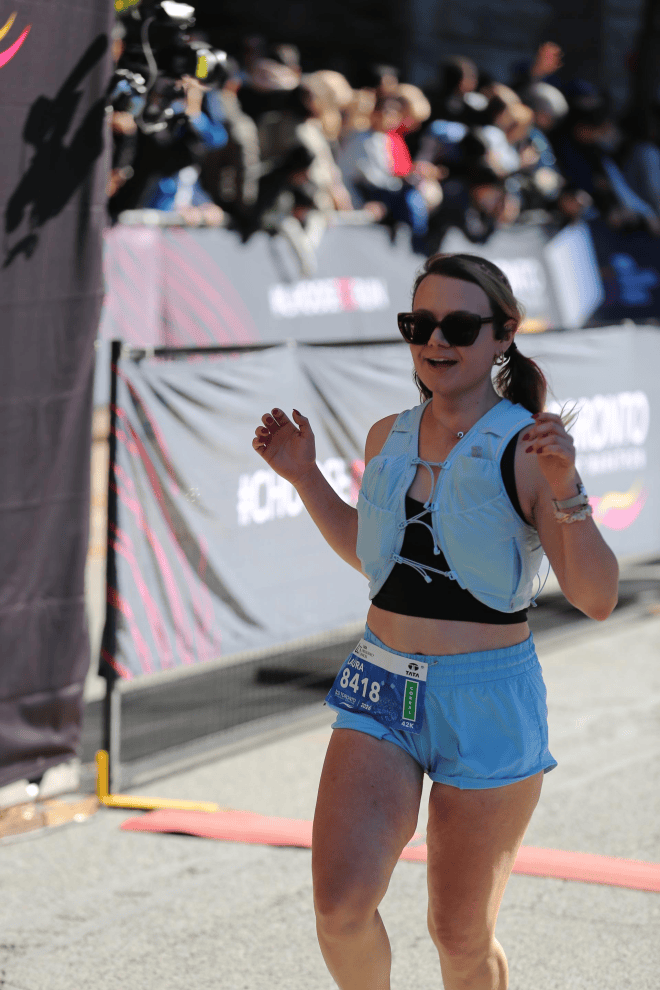
I wish I could say I felt a wave of emotion when I finally crossed the finish line, but all I felt was relief that I could finally. stop. running. I had expected to cry, but I honestly don’t think I had it in me to do anything except accept my medal and complimentary banana, and limp away to find somewhere to sit down. I finished the race in four hours and thirty-eight minutes.
Post- Race Reflections
Given some time to reflect on the race, I’m having mixed feelings about the experience. While I’m so proud that I finished the race, and satisfied with the time I finished in, I felt I didn’t truly enjoy myself. Because of everything that happened during the taper, I felt like I needed to be hypervigilant about how my body was feeling instead of enjoying myself and the experience. True to my doctor’s orders, throughout the entire course, I was diligent about fueling with running gels and stopping at every single water station. I didn’t push myself too hard, and I walked or stopped when I felt I could use the breaks.
While I’m ecstatic to have completed the race, it didn’t turn out how I expected, and I didn’t run the race I had trained for. On the other hand, in so many ways, running this race proved to me just how tough and resilient I really am, and how much I grew throughout the last twenty weeks.
As much as I would love to see how I’d perform in a marathon with an unremarkable taper, I don’t think I’ll ever be running one again. Or, at least… you’d have to wait and ask me again in a few months when the memories from this training block aren’t so fresh. My next challenge will be taking on the Canadian winter, which I’m already dreading. The days are already short and cold, and only getting shorter and colder. I’m planning to take a few weeks of genuine rest and recovery with running before getting back into a lower-volume winter routine. In the meantime, I’m also going to be completing “Walking in this World”, the sequel to Julia Cameron’s “The Artist’s Way”, a creative recovery program I completed last fall. Like last time, I’m planning to document this experience on a week-to-week basis with blog posts here.
Can you tell I’m Type A and don’t know how to relax?
Until next time,
Laura Kate

